 EN

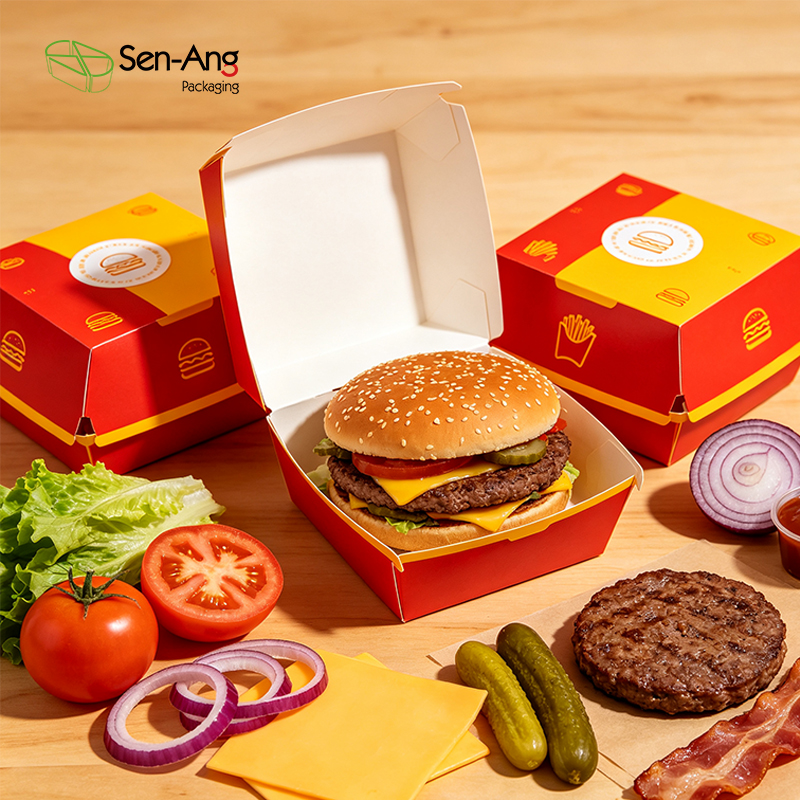
A burger travels badly. Steam softens the bun, grease soaks the base, and a box that buckles in a delivery bag turns a good kitchen into a bad review. Custom hamburger boxes exist to close that gap — they hold temperature, resist grease and present the brand before the first bite. In a category where menus are easy to copy, the box is one of the few parts of the experience a competitor cannot duplicate in a week.
This guide breaks the customer experience into the parts packaging actually controls: brand impression, the condition of the food on arrival, sustainability claims, handling, and the operating cost behind all of it.
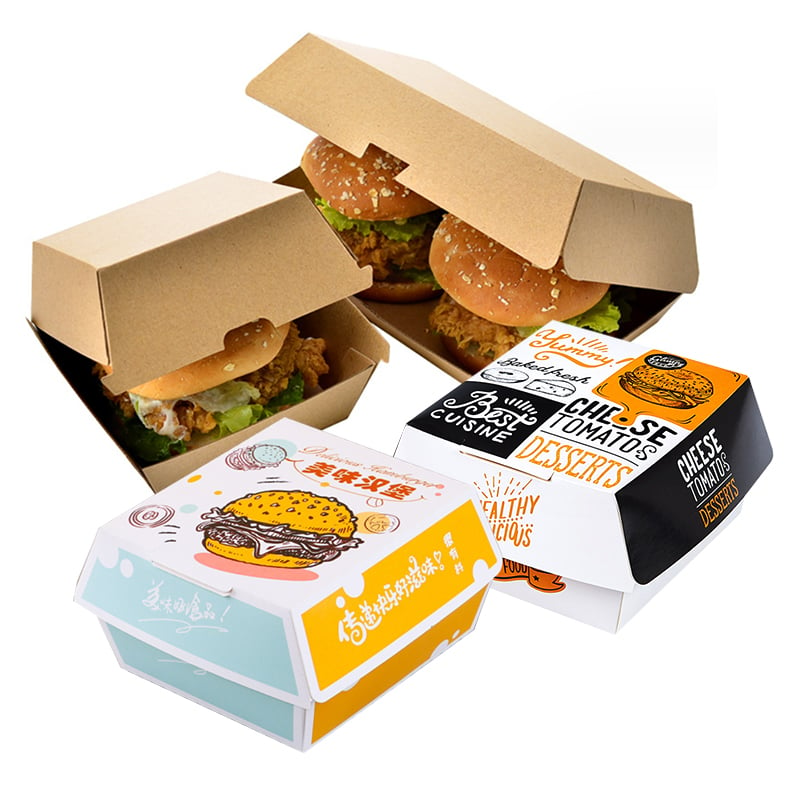
Brand Identity: What the Box Says Before the First Bite
A Moving Billboard in the Customer's Hand
Takeaway packaging leaves the store and keeps working. A box carried through a food court, an office or a park is seen by people who never saw the menu. Printed logos, brand colours and a clear product name turn that exposure into recognition, and recognition is what makes a customer choose the familiar name next time.
Print quality matters as much as the design. Crisp registration, dense solids and a clean surface read as professional; pale coverage and visible misregistration read as cheap, and customers transfer that judgement to the food inside.
Consistency Across Every Touchpoint
Custom hamburger boxes should look like they came from the same brand as the menu board, the app and the carrier bag. When colour, typeface and logo placement hold across all of them, the experience feels deliberate. That coherence builds trust at speed, because the customer no longer has to decode whether the box belongs to the brand they ordered from.
It also scales across a menu. One structural family can carry a signature burger, a kids' meal and a limited-edition item, with the difference handled in print rather than in a new die.
Functional Performance: What Custom Hamburger Boxes Must Deliver
Temperature, Condensation and Venting
Custom hamburger boxes that seal completely trap steam, and steam is what turns a toasted bun soft within ten minutes. Venting — small die-cut slots or a controlled gap at the lid — lets moisture escape while keeping heat in. Board weight and the internal coating decide how long that balance holds during a twenty-minute delivery.
Condensation is the second problem. A cold drink beside a hot burger puts water on the inside of the lid, which then drips onto the food. A coating that resists moisture on both faces, and a lid that does not sit directly over the patty, remove most of that risk.
Grease Barriers and Box Construction
Grease is the failure customers notice first: a translucent base, a softened corner, a box that loses its shape when lifted. Food-grade board with a grease-resistant barrier holds up under a heavy patty and a portion of fries, and a glued corner holds better than a folded tab that relies on friction.
Structure should also survive stacking. Custom hamburger boxes are stacked in the pass, in the delivery bag and in the customer's hands, and a box that collapses under two layers takes the presentation with it.
| Customer complaint | Usual cause | Specification that fixes it |
|---|---|---|
| Soggy bun | Trapped steam, no vent path | Vented lid, coated board, shorter hold time |
| Grease bleed | Uncoated base, board too light | Grease-resistant liner, higher board weight |
| Crushed corners | Weak corner glue, over-stacking | Glued corners, tested stack load |
| Print rubs off | Unsealed ink, no varnish | Sealed ink, matte or gloss varnish |
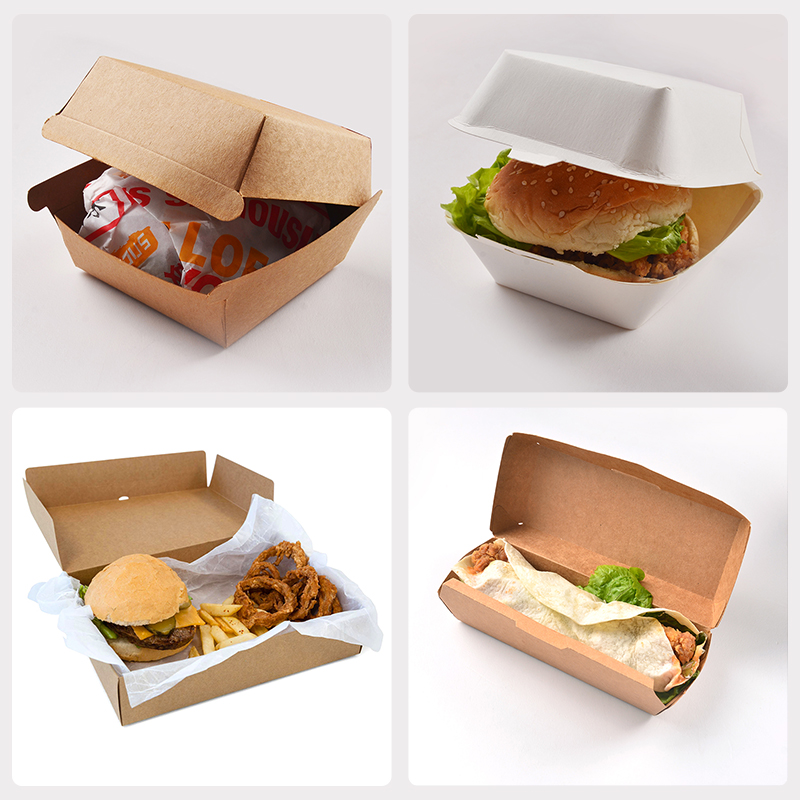
Sustainability That Does Not Cost Performance
Materials and Coatings
Buyers increasingly ask what custom hamburger boxes are made of before they ask the price. Recycled and responsibly sourced board, water-based coatings and paper-based closures let a brand make a claim it can document. The practical test is whether the greener specification still holds a hot, greasy product for the same time — a compostable box that leaks is not a sustainability win.
Right-Sizing to Cut Waste
Custom hamburger boxes can be built around the actual product rather than a generic size. A box that fits a single patty without spare volume uses less board, ships more units per carton and stops the burger sliding during transport. Right-sizing is the cheapest sustainability measure available, because it cuts material and freight at the same time.
Convenience and Communication
Carrying, Opening and Reclosing
Customers open custom hamburger boxes one-handed, in a car, on a desk, with a phone in the other hand. A lid that hinges cleanly, a closure that re-seals and a base that does not flex all remove the small frustrations that shape a review. For delivery, a closure that survives a tilted bag matters more than any decorative detail.
Printed Information and QR Codes
The outside of the box is free media. Allergen and ingredient notes, reheating guidance, a QR code to a loyalty programme or a feedback form all fit on a panel that is already being printed. Custom hamburger boxes carry that information at no extra cost per unit, because the print run is happening anyway.
Operational Cost Behind the Experience
Storage, Stacking and Labour
Flat-packed boxes save storage, but only if the fold is obvious. A pre-creased, pre-glued design assembles in seconds and shortens training during seasonal hiring. Standardised sizes simplify reordering and let staff grab the right box without checking dimensions during a rush.
Ordering custom hamburger boxes in volume changes the unit price more than most buyers expect. A factory running four automatic box gluing machines at a daily output of around 900,000 pieces can absorb a large seasonal order, while a short run in a new size carries setup cost that appears in the quotation.
FAQ
What materials are used for custom hamburger boxes?
Food-grade paperboard is the standard, with corrugated board for heavier or stacked orders and moulded fibre for compostable formats. The board needs a grease-resistant barrier and a coating that tolerates steam. The right specification depends on holding time, product weight and whether the box travels by delivery.
How do custom hamburger boxes affect delivery quality?
They decide whether the food arrives in the condition the kitchen sent it. Venting controls sogginess, a grease barrier protects the base, and a secure closure prevents spills inside the bag. Intact branded packaging also raises the customer's confidence before the lid opens, which shows up in ratings.
Which design details matter most?
Vent placement, board weight, corner construction and lid fit. For custom hamburger boxes, print comes second, but it should still be checked on the assembled box rather than on a flat proof, because curvature, fold lines and coating all change how a logo reads in the hand.
How can a restaurant measure the return on custom packaging?
Track repeat order rate, delivery rating, complaint reasons and packaging cost per order before and after the switch. Most of the return comes from fewer remakes and better reviews rather than from the box itself, so compare the same menu over the same delivery radius.
A box cannot rescue a bad burger, but it can decide whether a good one arrives that way. Custom hamburger boxes are the last physical control a kitchen has over the experience, and the cheapest place to protect the reputation the food has already earned.