 EN


A branded cup is the only piece of marketing a dessert shop hands to the customer and expects them to carry away. It is seen at the counter, in the street, at a table and in a photo, and it costs the same whether the shop sells one scoop or three. That combination — portable, repeated, already paid for — is why custom ice cream cups outperform most paid channels per pound spent.
The mechanics are less mysterious than they sound. Visibility comes from three things: how the cup reads at a distance, how often it leaves the shop, and how well it survives condensation long enough to be photographed.

Why Custom Ice Cream Cups Work as Media
Cost per Impression
A paid impression stops when the budget stops. A cup keeps working for the length of the walk, and the print cost is settled once per production run rather than per view. For a shop with steady daily volume, that converts packaging from a cost line into owned media with a fixed price.
The comparison is not close for small operators. A social campaign buys reach that disappears; a print run leaves something in the storeroom that keeps generating exposure until the last cup is used.
What Actually Leaves the Shop
Not every cup travels. Dine-in cups stay on the table, and some are discarded within minutes. The cups that matter are the takeaway orders — the customers walking through the busiest public spaces with the brand at eye level. That is why the design brief should start from the street, not from the counter display.
Designing for Distance and Hand
Logo Position on a Tapered Cup
A tapered cup compresses artwork near the base and stretches it at the rim, and a hand covers roughly the lower third. On custom ice cream cups, the practical zone for a primary mark is the upper band, positioned so it stays visible when the cup is held naturally. A logo placed centrally often disappears behind fingers.
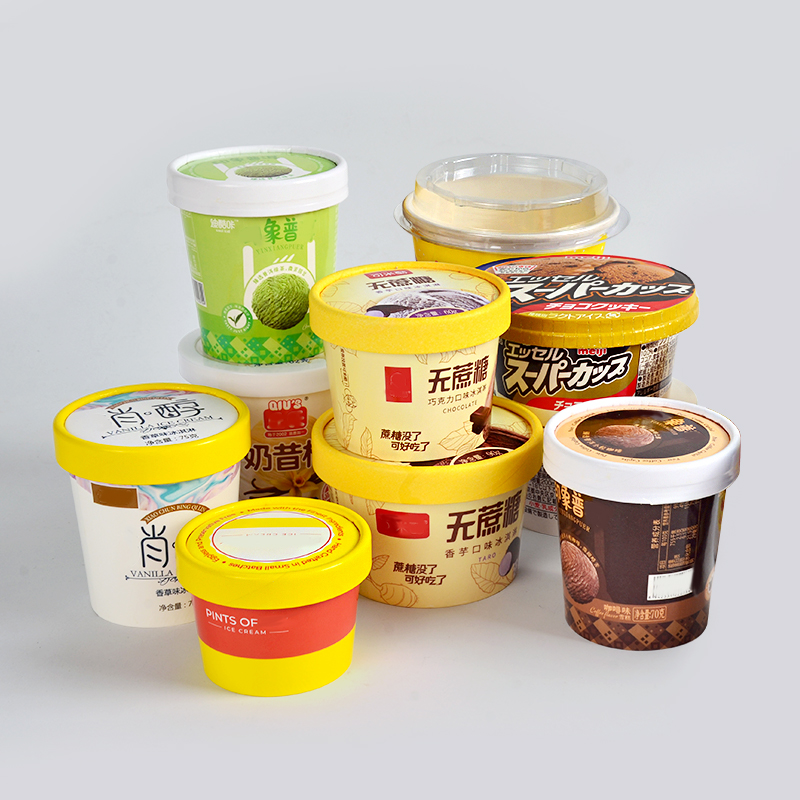
Wrapping matters too. A single mark printed once on a 360-degree surface is invisible from two-thirds of the angles it will be seen from. Repeating the mark two or three times around the circumference raises the odds that any given view carries the brand.
Colour, Type and the Wet Test
High contrast survives distance; subtlety does not. Two colours with strong separation read from across a room, while a four-colour gradient turns to mud at ten metres. Type follows the same rule: one legible word beats a strapline nobody can resolve.
Then test it wet. Custom ice cream cups meet condensation within a minute of being filled, and ink that scuffs or blushes under moisture destroys the design exactly when the customer photographs it. Print a sample, fill it, leave it on a table for ten minutes and look at it again.
Manufacturing Reality
Print Methods and Run Sizes
Flexo printing is the economical route for long runs and simple colour sets; offset gives finer detail and more accurate brand colour; digital makes short runs viable without plates, which is what allows a small shop to order a seasonal design at all. The right method follows the artwork and the volume together.
Setup for custom ice cream cups is charged once per run rather than per cup, so unit cost falls as quantity rises. That is why custom ice cream cups reward planning: a single larger run with two designs usually beats two small runs of the same total quantity.
Food Contact, Coating and Lid Fit
Ink and coating sit close to the product, so both need food-contact documentation for the exact construction being printed. A cup sold as compostable needs a coating that supports the claim, and a lid that does not seat properly turns a good print job into a complaint about leaks.
Using the Cup in Campaigns
Seasonal Editions Without New Tooling
Because the cup structure stays the same and only the print changes, a seasonal edition is a design decision rather than a tooling investment. A summer design, a holiday version or a collaboration with a local illustrator all run on the same specification, and each gives regular customers a reason to return and social media something new to show.
The constraint is scheduling. Print runs are planned in advance, so a seasonal design ordered a few weeks ahead is routine; one ordered the week before is a rush job at a rush price.
QR Codes, Loyalty and Partnerships
A cup can carry one action, and it should carry only one. A QR code that opens a loyalty sign-up, a map listing or a review page is enough. Keep it on a flat panel with strong contrast, and test it after forming rather than on a flat proof, because curvature and gloss change how a phone reads it.
Event work is the other underused channel. Custom ice cream cups branded for a wedding, a corporate function or a festival carry the brand into rooms it would never otherwise enter, and the organiser gets a detail that looks considered.
| Design decision | Effect on visibility |
|---|---|
| Mark repeated around the cup | Visible from more angles while carried |
| Two-colour, high contrast | Readable at distance and in photos |
| Scuff-resistant ink | Survives condensation until the photo is taken |
| One QR action | Converts a cup into a measurable step |
FAQ
What should be printed on custom ice cream cups?
A legible mark, the brand name and one supporting line — usually a handle or a QR code. Everything else competes with the logo. Test the layout at real size on a curved cup before approving.
What order quantity makes custom printing worthwhile?
The quantity at which the setup cost stops dominating the unit price, which depends on the print method and the size. Ask for quotes at two or three volumes and compare cost per cup rather than the total.
Can eco-friendly cups still print well?
Yes. Uncoated and water-based coated boards take four-colour print well; the difference is in ink absorption and sheen, so the artwork should be proofed on the actual substrate rather than on a generic white sheet.
How often should the design change?
Keep the mark, palette and layout stable, and change the campaign layer — a seasonal pattern, a collaboration, an event lock-up. Recognition compounds only if the core identity stops moving.
Custom ice cream cups boost visibility because they turn a disposable object into a repeated, portable impression at almost no marginal cost. The brands that win with them treat the cup as a media buy with a specification, not as a container chosen at the last minute.