 EN


The case for square bowls is usually argued on shelf space, and that is only half the geometry. Squares do use a footprint more efficiently, but they nest less tightly than round bowls, and their corners concentrate stress in exactly the place a moulded bowl tends to crack. Whether the trade is worth it depends on which of those two effects dominates in your operation.
This article sets out where the square format genuinely wins, where it quietly costs more, and what to specify so the corners are not the weak point.
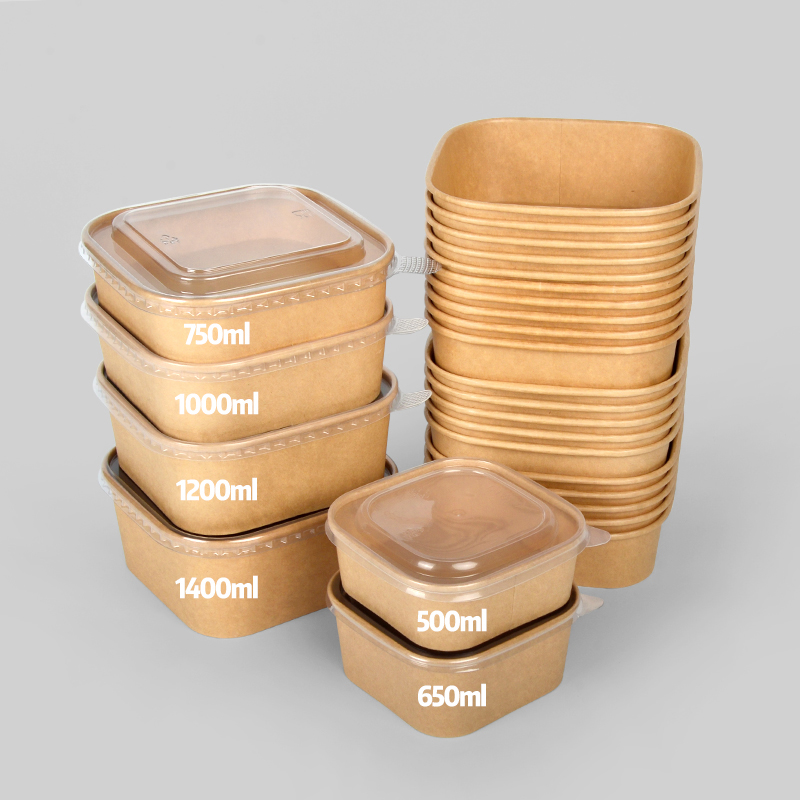
Where Square Bowls Win on Footprint
Pallet, Shelf and Carton Cube
Round bowls leave gaps between them; square bowls do not. On a shelf, in a carton or on a pallet, the same footprint holds noticeably more square bowls, and that difference compounds along the chain: fewer cartons per order, fewer pallets per container, less shelf space per facing.
The second gain is alignment. Square bowls sit flush against each other and against a carton wall, so a display stays tidy and a pallet stays square. Round bowls roll and drift, which costs staff time in straightening and occasionally costs product in a fall.
For delivery, the flat edge is also a practical advantage: a square bowl does not rotate in a bag, so the lid stays where it was put and the sauce stays at one end.
Where Square Bowls Cost More
Nesting and Stack Height
This is the counter-argument that rarely appears in a design brochure. Round bowls nest deeply because the taper is uniform in every direction; square bowls nest only as far as the wall taper allows, and the corners tend to bind first. A pallet of nested round bowls can hold more units than the footprint maths suggests, which can erase the square advantage in storage.
The practical test is simple: ask for the nested stack height of a hundred units for both formats, then calculate cartons per pallet. That number, not the footprint, decides warehouse cost.
Corners Are Stress Points
In a moulded fibre or formed paper bowl, the corner is where the material stretches thinnest and where a crack begins. A square bowl needs a larger corner radius, a slightly heavier wall at the corner, or both, and a supplier who only changes the outline will deliver a bowl that fails at the base corner under a heavy portion.
Sealing is the second corner problem. A round rim accepts a lid or a film evenly; a square rim has four radii that must match the lid exactly, so a fraction of a millimetre out produces a leak at one corner rather than all round. Approve the lid with the bowl, never separately.
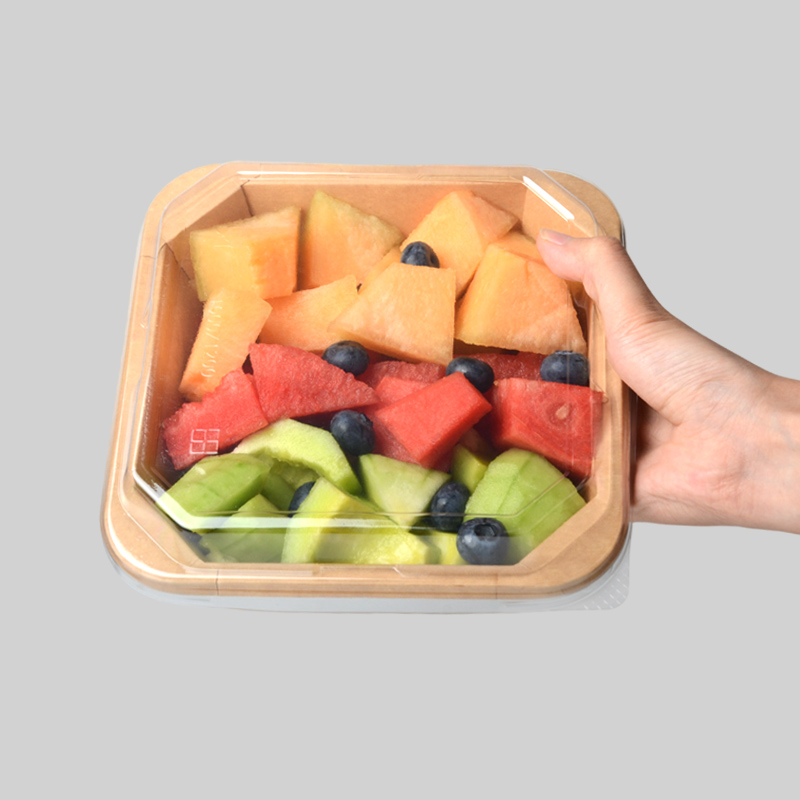
Presentation and Portion
Compartments and Plating
Square bowls give a menu designer straight edges to work with. Components can be arranged in bands or blocks, and a compartment insert in a square format produces clean divisions rather than wedges. For grain bowls, bento-style sets and salad boxes, that geometry makes a portion look composed without any extra labour.
The flat side also helps portion control: a straight edge is easier to fill to than a curve, and staff can level a scoop against it quickly during a rush.
Photography and Brand
Square bowls photograph with fewer empty corners in frame, and a flat face gives the printer a reliable panel for a logo. In a delivery feed where every competitor uses a round bowl, the format itself is a differentiator before the print is read.
Cost and Tooling
Moulds, Dies and Minimums
A square bowl is not a round bowl with the corners added; it needs its own mould or die, and usually its own lid tool. That means a one-off charge and a minimum economic quantity, which is why square bowls are often quoted higher at low volume and level with round ones once the run is long.
Where a range already exists, the cost difference is small. Where it does not, the tooling should be spread across the realistic annual volume before the format is judged expensive.
Freight Reality
Freight follows volume, not weight. Square bowls pack better inside a carton, but if they nest worse, the carton may still be taller. Ask for units per carton and cartons per pallet for both formats and compare landed cost — that is the only number that settles the argument.
| Dimension | Square bowls | Round bowls |
|---|---|---|
| Footprint use | No gaps; flush against walls | Gaps between units |
| Nesting depth | Shallower; corners bind | Deep, uniform taper |
| Corner strength | Needs larger radius or heavier wall | Even stress distribution |
| Lid sealing | Four radii must match exactly | Single continuous rim |
| Presentation | Bands, blocks, clean compartments | Wedges, softer arrangement |
FAQ
Are square bowls more expensive than round ones?
At low volume, yes, because they need their own mould or die and their own lid. At volume the piece price is usually close; the difference moves to nesting and freight.
Do square bowls work for all foods?
For most, and especially for set meals where compartments help. Soups are the awkward case, because corners are harder to seal and easier to catch on a lid.
Are they harder to seal?
Slightly. Four radii have to align with the lid, so tolerance matters more than on a round rim. Approve the bowl and lid as a pair and test filled and tilted.
Will existing equipment handle them?
Shelving, chillers and delivery bags generally will. Cup holders, dispensers and any equipment built around a round aperture will not, so check the filling line before ordering.
Square bowls win on footprint, alignment and presentation, and lose some of that on nesting and corner strength. The decision should come down to cartons per pallet and a filled-bowl test, not to the shape alone.