 EN


A water-based coating is not a thinner version of plastic. It is a dispersion that dries into a film, and that difference explains both what it does well and where it gives up: excellent resistance to water over a normal service window, weaker hold on hot grease, and a bowl that can usually be repulped instead of being sealed in polyethylene. Water-based coated kraft bowls are worth specifying for exactly those reasons — and only when the menu fits the window.
This article explains what the coating is, what it realistically holds, and how the end-of-life story changes once the bowl is empty and soiled.
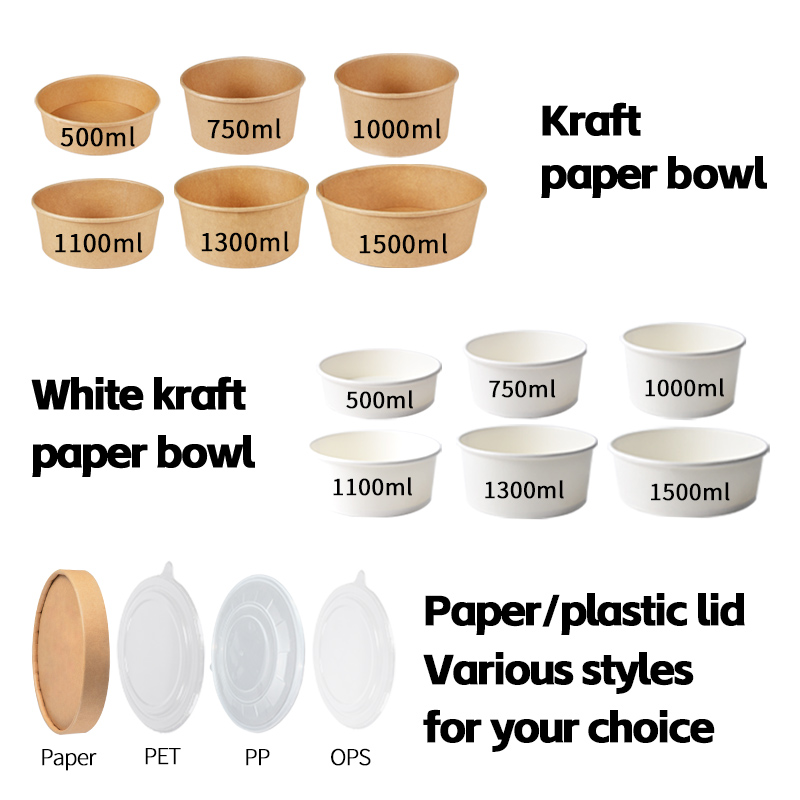
What the Coating Actually Is
Dispersion, Not Film
A water-based barrier is applied as a dispersion of polymer particles in water. As it dries, the particles coalesce into a thin film that is continuous but not chemically bonded to the board the way an extruded polyethylene layer is. That is why the bowl still feels like paper, and why it can often be repulped with the fibre rather than separated from it.
The trade-off is mechanical. A thinner, less elastic film resists water well but is more easily damaged by abrasion and by hot oil, and coverage has to be uniform: a pinhole becomes a soft spot within minutes.
What It Does and Does Not Do
Water-based coated kraft bowls hold soup, sauce and slaw for a normal delivery window. They are less reliable with very hot, very fatty food over long contact, where an extruded PE lining still has the edge. They are also not a moisture barrier in the sense plastic is — the board still breathes, which is an advantage for fried food and a limitation for anything held for hours.
That combination makes the format a good fit for grain bowls, salads, noodles and moderate sauces, and a poor fit for a two-hour hot hold.
Performance of Water-Based Coated Kraft Bowls
Hot Liquid, Grease and Time
In water-based coated kraft bowls, almost every failure is a function of time rather than temperature. A bowl that performs at ten minutes may soften at forty, and the base seam is where it starts. Ask the supplier for a tested holding period, then test it yourself with the real dish at service temperature rather than with water.
Grease is the second variable. Water-based coatings resist oil less strongly than PE, so a very oily dish needs a dedicated grease-resistant grade rather than the standard water barrier. Specifying "water-based" without naming the grease requirement is how a bowl ends up translucent at the base.
Breathability and Condensation
Because the board still transmits vapour, condensation builds up less than in a sealed plastic container. For fried items and baked goods that is a genuine quality advantage: the crust stays crisp without a venting feature. For chilled salads, the same property means the bowl does not sweat, which protects the print.
End of Life for Water-Based Coated Kraft Bowls
Composting Conditions
Water-based coated kraft bowls are only compostable where the specific construction is certified and a facility accepts food-soiled packaging. The coating helps, but it is not a guarantee: certification has to name the finished bowl, and the destination facility has to take it. Without both, the bowl behaves like any other paper container in general waste.
Recycling Reality
The coating's real advantage appears at the pulper: water-based films disperse and can be repulped with the fibre, where PE has to be separated. That makes these bowls more likely to be accepted by mills that take coated stock.
Collection is the bottleneck, not repulpability. A used bowl is usually greasy, and most collectors reject food-contaminated paper. The honest claim is therefore "repulpable where the mill accepts it", not simply "recyclable".

Cost, Supply and Brand
Cost and Freight
At volume, water-based coated kraft bowls sit close to PE-lined bowls on piece price, and the differences move to freight and storage. Bowls are bulky: carton dimensions decide how many units fit in a container, and a taller carton can cost more across a shipment than a discount on the unit price saves.
Print and tooling are charged per run rather than per bowl, so a branded bowl gets cheaper as quantity rises. Standardising on two or three sizes saves more than squeezing the unit price.
Brand and Print
Kraft takes four-colour print, hot stamping and spot UV, and one strong colour on the natural tone usually beats a full-bleed design fighting the substrate. The bowl is often the only branded object a delivery customer keeps, which is why the print budget is easier to defend than a poster.
| Property | Water-based coating | PE lining |
|---|---|---|
| Water resistance | Good for a normal service window | Strongest, holds for hours |
| Grease hold | Weaker; needs a dedicated grade | Strong |
| Repulpability | Disperses with the fibre | Must be separated |
| Composting | Possible with the right certification | Effectively rules it out |
FAQ
How long do they hold hot liquid?
Long enough for a normal delivery, but it depends on the grade and the dish. Ask for a tested holding period and verify it with the real product; a bowl that passes at ten minutes can fail at forty.
Are they microwave-safe?
Usually yes, since the coating contains no metal, but the lid and any foil component may not be. Print the answer on the bowl rather than leaving the customer to guess.
How should they be disposed of?
Compost where certification and a facility exist; otherwise general waste. Clean bowls may be accepted by mills that take coated stock, but greasy ones usually are not.
Do they preserve food as well as plastic?
Differently. They match plastic on containment for a normal service window and beat it on condensation, but they are not suitable for multi-hour holding or freezer storage.
Water-based coated kraft bowls offer their benefits in a narrow but useful band: short service windows, moderate grease, and a waste route that can handle fibre. Specify the grease grade and the holding time, and the coating does what it promises.