 EN


A cake box has an unusual job: it must protect something fragile, release moisture so icing does not sweat, resist butter and cream at the corners, and still look like a gift when it is handed over. paper cake boxes do most of that well — but the sustainability claim usually hinges on one small component nobody discusses: the window.
This article separates what paper genuinely delivers from what needs a specification, and explains why a clear window can quietly undo an otherwise recyclable box.
Where Paper Cake Boxes Genuinely Win
Fibre, Weight and Freight
The fibre is renewable, and with chain-of-custody certification it can be traced to a mill. Paper cake boxes also ship flat, which is the advantage buyers underestimate: a carton of flat blanks holds many times the boxes of an equivalent stack of rigid containers, so storage in a small bakery and freight per unit both fall.
Weight compounds it. A folded board box weighs a fraction of a rigid plastic clamshell, and for a bakery delivering locally that difference shows up in every run rather than once.
Print and Perceived Value
Paper takes four-colour print, hot stamping, embossing and spot UV, and it does so at short runs. For a patisserie, the box is the last physical object the customer keeps, and a matte board with restrained print reads as craft in a way a glossy plastic lid does not. Print is charged per run rather than per box, so the branded box gets cheaper as volume rises.
Where the Claims Need Care
Paper Is Breathable, Not a Barrier
Paper cake boxes manage moisture by letting it move, not by blocking it. That is an advantage for a butter cake that would otherwise sweat under a sealed lid, and a disadvantage for anything very wet or held for days. A box described as having "excellent moisture protection comparable to plastic" is overselling: the board will soften if the product releases enough water.
Grease is the more common failure. Cream, butter and chocolate mark an uncoated board within hours, and the mark spreads through the base. A grease-resistant liner solves it; the liner choice then decides whether the box can be composted at all.
The Window Is the Weak Link
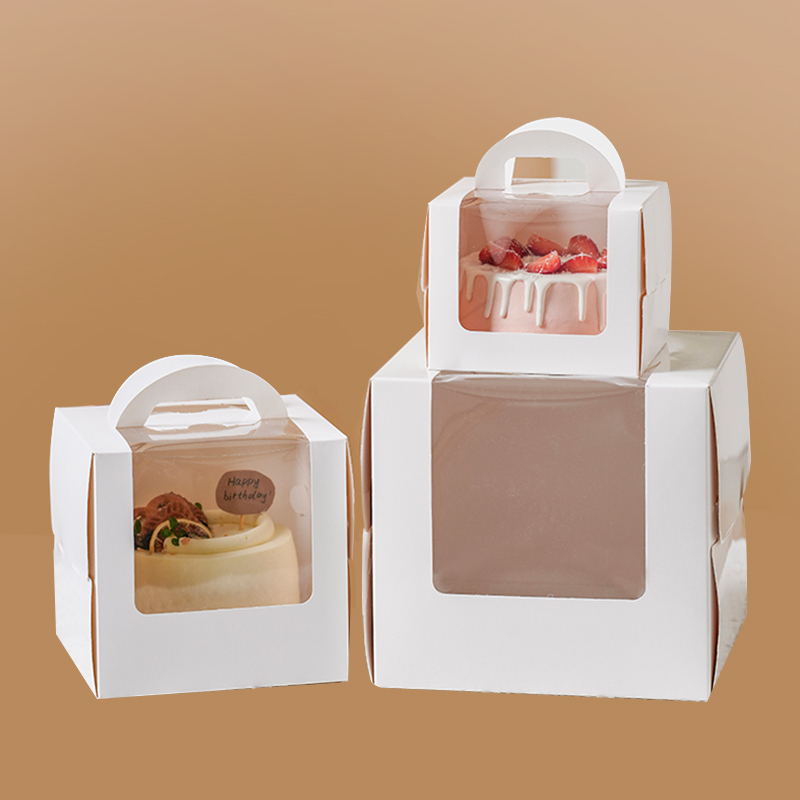
Window paper cake boxes are the default for celebration cakes, and the window is usually PET or PP film glued or heat-sealed into the lid. That film is not paper, is rarely separated by the customer, and generally disqualifies the box from both paper recycling and composting.
If a sustainability claim matters, the options are a paper window (translucent, less clear), a PLA film that composts under industrial conditions, or no window at all with a printed lid. Each is a real trade-off between visibility and end of life, and it should be decided before the artwork, not after.
Structure and Product Fit
Board, Crease and Stacking
Stiffness matters more than thickness in a cake box. A heavier board holds a crisp crease and keeps the walls square when the lid is closed; a light one bows, and a bowed wall is where the corner seam separates. The base construction matters most, because a cake is carried from below and the load concentrates at four points.
Stacking is the second test. Cake boxes are stacked in a van and on a counter, and the bottom one carries the weight of the ones above. A box that passes empty can still fail under two filled boxes, so the stack limit should be tested with the real product.
Inserts, Tiers and Assembly
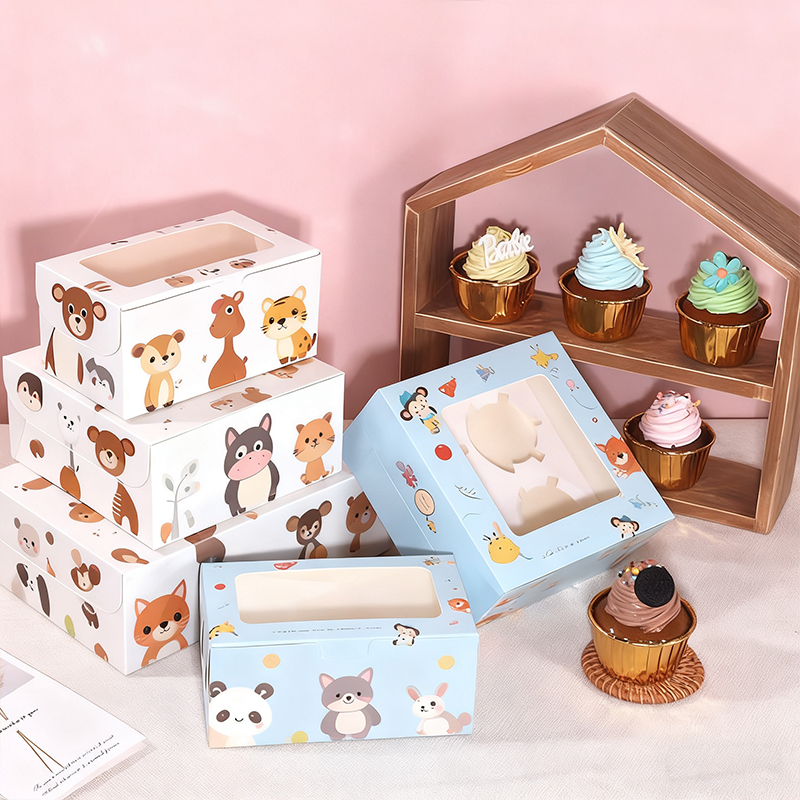
Inserts and dividers in paper cake boxes do two jobs: they stop a tier sliding and they make a multi-item box look composed. A pre-creased blank assembles in one movement, which matters in a bakery where boxes are folded between customers rather than in a back room.
Standardise where you can. Two or three footprints with one insert family usually cover a patisserie menu and keep both tooling and shelf space manageable, while a bespoke die for every cake adds cost the customer never sees.
Cost and Compliance
Landed Cost and Flat-Pack
Compare cost per order rather than per box. Paper cake boxes usually sit close to plastic on piece price at volume, and they win on storage and freight because they ship flat. The hidden cost is damage: a crushed carton produces creased blanks that cannot be sold at full price, so packaging and pallet configuration matter.
Rules and Claims
Paper cake boxes usually sit outside single-use plastic restrictions, which is a compliance advantage before it is an environmental one. But the claim printed on the lid has to match the construction: a window film, a laminated exterior or a plastic ribbon all change what can be said. Where extended producer responsibility fees apply, the material choice also carries a recurring cost.
| Component | Common choice | Effect on end of life |
|---|---|---|
| Board | Coated or uncoated kraft | Coating decides repulpability |
| Window film | PET, PP, PLA or paper | Plastic film blocks both routes |
| Ribbon or handle | Paper, cotton, satin | Synthetic ribbon is not separable |
| Ink | Water-based, food-safe | Easier to de-ink than solvent |
FAQ
How do paper cake boxes handle moisture compared with plastic?
Differently, not better. Paper lets moisture escape, which suits most cakes and prevents condensation; it does not block water, so very wet fillings or long storage need a barrier and a shorter shelf assumption.
Do they cost more than plastic packaging?
Piece prices are often close at volume, and paper usually saves on storage and freight per unit. Damage rates and carton configuration can erase that, so compare landed cost per order.
Are they suitable for all baked goods?
For most, yes. High-fat or long-shelf-life items need a grease barrier or a different format. The box should be chosen against the product's moisture and fat content, not against a catalogue size.
How should used paper cake boxes be disposed of?
Remove the window film and any ribbon, then check local rules: clean board usually recycles, food-soiled board usually does not, and coated board needs a facility that accepts it. Composting depends on both the coating and the facility.
Paper cake boxes are a smart sustainable choice because the format is renewable, printable and cheap to store — provided the window, the coating and the ribbon are chosen with the same attention as the board. That is where most of these boxes stop being recyclable.